
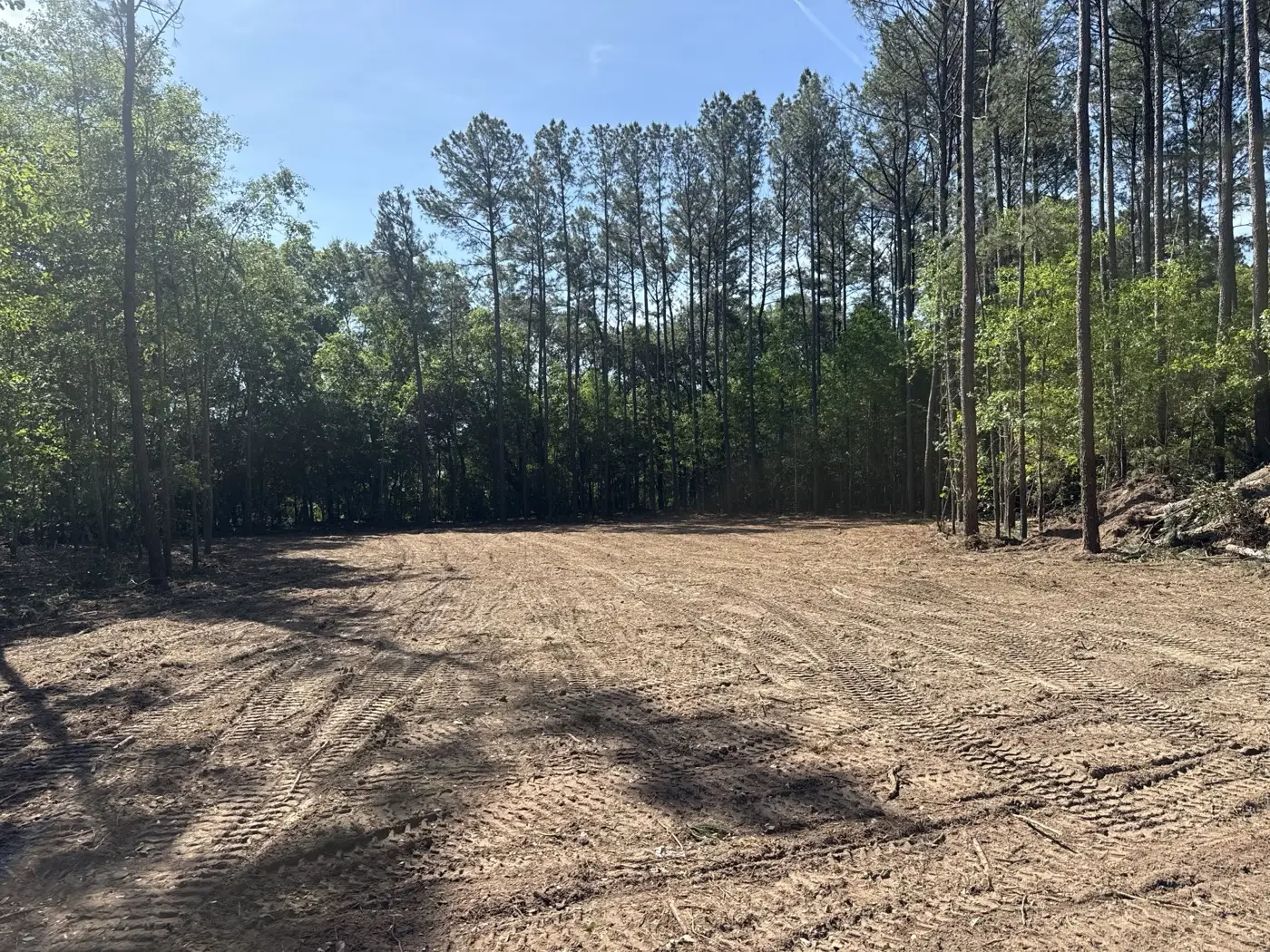
Do you need a permit to clear land in South Carolina?
For most private lots in South Carolina, clearing brush and trees needs no state permit. The line is one acre of disturbed ground. Burning what comes off calls for a notification to the Forestry Commission instead of a permit. Wetlands, city tree rules and buried lines each carry a separate rule.
When does land clearing need a permit in South Carolina?
South Carolina ties the permit to how much ground you disturb. SCDES requires stormwater permit coverage for clearing, grading, excavating or filling that hits one acre or more. Under an acre, you file a short notification form instead. Your city or county can still ask for its own filing.
The state law behind it is the Stormwater Management and Sediment Reduction Act. It defines a land disturbing activity as any use of land that changes the natural cover or topography. The same law lists exemptions. Farm work, timber production and a single family home built on its own lot sit outside it. SCDES still asks for a Notice of Intent when clearing disturbs one acre or more, so ask before you lean on an exemption.
We check the acreage and the address before any land clearing starts, because the answer moves at the city line.
| Disturbed area | What is required | Who reviews |
|---|---|---|
| Less than 1 acre | Notification form for sites disturbing less than 1 acre (SCDES Form 2628). A letter of exemption follows | SCDES, plus the city or county stormwater program |
| 1 to 2 acres | Coverage under the Construction General Permit: a Notice of Intent and a simplified stormwater pollution prevention plan | SCDES, or the local MS4 program |
| More than 2 acres | A Notice of Intent and a full stormwater pollution prevention plan prepared by a licensed South Carolina professional engineer, landscape architect or Tier B land surveyor | SCDES, with local MS4 review |
Source: South Carolina Department of Environmental Services, stormwater rules for construction activities (des.sc.gov).
What does a land disturbance permit involve around Florence?
Around Florence the paperwork usually starts local. The City of Florence and Florence County each run a stormwater program. Plans go to an engineering office before anything else. You file a Notice of Intent, a site plan and a stormwater plan sized to the acreage.
SCDES publishes the state fee. A standard review costs $125 plus $10 for each tenth of an acre disturbed. It tops out at $2,125. The Florence County form for sites under one acre states that no application fee is required.
Florence County gives its Engineering Division 20 working days to approve or comment. A house or barn coming down on the same land needs its own application. The county lists a demolition permit with its building forms. We cover the permit rules for tearing down a structure in a separate guide.
Do you need a burn permit in South Carolina?
South Carolina does not issue a burn permit. State law requires a notification to the Forestry Commission before you burn outdoors. That law covers unincorporated areas only, so it stops at city and town limits. Land clearing burns next to woods, brush or grassland carry the same notification.
The fastest route is the online form at scfc.gov/notify. By phone, the Commission publishes a toll-free line for each county.
What goes on the pile matters. The Forestry Commission limits residential yard debris burns to vegetative material like leaves, limbs and branches. Burning waste from a commercial construction site is against the law.
The Commission sets conditions on a yard debris burn. Keep the fire to vegetative material and clear a firebreak around the site. Stay with the fire until it is completely safe. The State Forester can also prohibit all open burning when public safety calls for it.
Inside the city limits the local ordinance takes over. The City of Florence states that the burning of solid waste is prohibited. It also does not collect land clearing waste from private property.
Removing that waste falls to the owner or the contractor. We load cleared piles into the dump trailer and haul them off.
Can you clear wetlands or creek banks on your land?
Wet ground changes the answer. Section 404 of the Clean Water Act covers waters of the United States, wetlands included. It requires a permit before dredged or fill material is discharged there. A delineation tells you whether the rule reaches your land.
The Army Corps of Engineers administers the day to day program and makes the permit decisions. Florence County asks for a delineator report when a site shows wetland indicators. Water impacts have to be permitted before work can begin.
If part of your ground stays wet, say so when you call. We can leave that section alone and clear the rest.
What about trees inside the Florence city limits?
The Florence Unified Development Ordinance sets the tree rules inside the city. Individual lots of record used for an existing single family or two family dwelling are excepted from Article 10. Protected trees on multi-family, nonresidential, mixed use or institutional property need an individual tree removal permit from the Director.
The ordinance keeps its own table of protected species and their sizes. It covers groups too, since a stand with interconnected canopies over 5,000 square feet counts as a significant stand. Preserving trees earns credit toward the landscaping requirements.
Downtown is stricter. In the downtown design districts a Certificate of Appropriateness comes first for tree removal without mitigation. The trigger is a hardwood at six inches diameter at breast height. Conifers count at eight inches and flowering or fruiting ornamentals at four inches.
We check the address first. The same check runs before single tree removal on a standing property.
Does forestry mulching change the picture?
The rule counts disturbed ground, not the machine. South Carolina defines a land disturbing activity as any use of land that changes the natural cover or topography. SCDES names clearing itself among the construction activities that need coverage. The acreage line holds either way.
Owners weighing lot clearing on private acreage against forestry mulching ask about this often. Either way the wetland rule still applies, and the locate request still comes first. Tell us the acreage and we will tell you which office wants a filing.
What has to happen before anything digs?
A locate request goes in first. SC811 asks you to submit it at least three business days before you start digging. That count excludes the day you file, weekends and holidays. Utilities then mark what is buried, and the machine works around the marks.
Pulling stumps and cutting in a driveway both break ground, so both need the ticket. South Carolina updated its Underground Facility Damage Prevention Act on May 22, 2026. Operators now give timely status updates so excavators can confirm markings before work begins.
How do you get a real answer for your parcel?
Have four things ready before you call anyone. The parcel or tax map number, and the acreage you plan to disturb. Whether the lot sits inside city limits, and whether any of it stays wet. With those four, an engineering office can answer in one call.
The filing stays with the owner. We point you at the right desk and tell you what to bring. Quotes are free and given on site.
Still pricing the job? Our guide to what clearing costs per acre in South Carolina lays out the ranges. When you are ready, send us the address for a free on-site look.
Questions people ask
Do you need a permit to clear land in South Carolina?
Most private lots need no state permit until the disturbed ground reaches one acre. SCDES requires stormwater permit coverage for clearing, grading, excavating or filling that hits one acre or more. Under an acre, the state takes a short notification form instead. Your city or county may still want its own filing.
What is a land disturbance permit?
It is stormwater permit coverage for work that changes the ground. In South Carolina it means a Notice of Intent and a stormwater pollution prevention plan sized to the acreage. SCDES or your local stormwater program reviews it. Around Florence, the city and county engineering offices handle that review.
Do you need a burn permit in South Carolina?
South Carolina does not issue burn permits. State law requires you to notify the Forestry Commission before burning outdoors, outside city and town limits. File online at scfc.gov/notify or call the toll-free line the Commission publishes for your county. Vegetative material only.
Can I clear wetlands on my property?
Wet ground needs a check before any fill moves. Section 404 of the Clean Water Act covers waters of the United States, wetlands included. It requires a permit before dredged or fill material is discharged there. The Army Corps of Engineers administers the program, and a delineation tells you whether your ground is in.
Do I need a permit to cut trees in Florence?
Inside the city, a lot of record with an existing single family or two family home is excepted. That exception covers the ordinance landscaping and tree standards. Protected trees on commercial, multi-family or institutional property need a tree removal permit from the Director. The downtown design districts add a Certificate of Appropriateness.
Do I have to call 811 before clearing?
Yes, before anything breaks ground. SC811 asks you to submit the locate request at least three business days before you start digging. That count excludes the day you file, weekends and holidays. Utilities mark what is buried so the machine stays clear of it.