
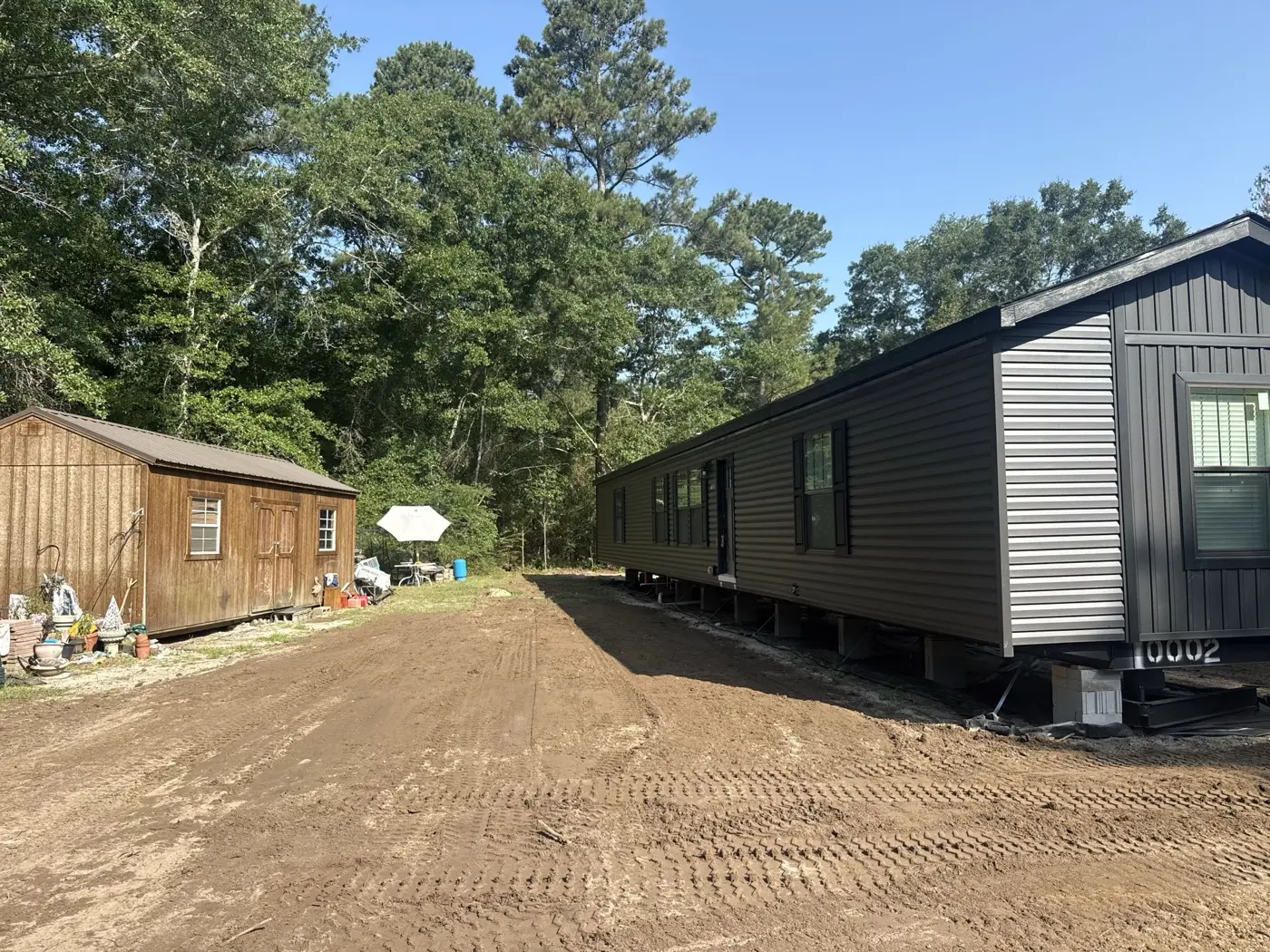
How do you prepare land for a mobile home in South Carolina?
Preparing land for a manufactured home runs in a fixed order: permits, then clearing, then the pad, then grading, access and utility rough-ins, and only then the set. The dirt phases commonly cost $2,500 to $15,000 before utilities. Get the order right and the set day is boring, which is the goal.
South Carolina also splits the job between two trades by regulation, and knowing where that line sits saves owners from paying twice or assuming someone else had it. Here is the sequence, the specs the pad must meet, and the local numbers.
What happens in what order?
The working sequence on a Pee Dee lot: county paperwork first, then staking the home and its setbacks, clearing the footprint plus working room, building and compacting the pad, cutting grade so water leaves, roughing in the drive so the transport can reach the pad, utility rough locations, and then the installer’s set day with blocking, anchoring and hookups behind it.
| Phase | Typical cost |
|---|---|
| Clearing and grading for the home | $2,500 – $15,000 |
| Lightly wooded acre, cleared | $500 – $2,000 |
| Heavily wooded acre, cleared | $3,000 – $5,600 |
| Gravel drive | $1.25 – $4.00 / sq ft |
| Septic system, where needed | $8,000 – $20,000 |
| Well, where needed | $4,000 – $8,000 |
| Block, level and tie-down (installer) | $5,000 – $15,000 |
| Skirting | $1,500 – $3,500 |
Manufactured homes are how a large share of this region houses itself: 17.7 percent of Florence County’s housing stock by the latest census figures, against 5.6 percent nationally, and neighboring Pee Dee counties run higher still. The site-prep sequence above is one of the most common jobs in our part of the state.
What must the pad itself meet?
The federal installation standard is specific, and South Carolina adopts it. Footings sit on firm undisturbed soil or on fill compacted to at least 90 percent of its maximum density. Organic material comes out from under the load points. Drainage is written in twice: the site sloped so water runs away from the home, with roughly a half inch of fall per foot for the first ten feet. The state rule adds its own floor, requiring the stand free of grass and organics and rated for at least 1,000 pounds per square foot.
Florence County’s own inspection checklist says it in plain English: the site must slope away from the home. Grading is not cosmetic on these jobs; it is an inspected item. On our flat, sandy-over-clay lots, that slope gets built, which is the heart of the grading and site prep work. The drive matters the same way, both for the transport and for every rainy week after, and it usually goes in with the pad as one gravel drive project.
Who is responsible for what?
South Carolina draws the line by license. An installer’s license covers transport, stand preparation, placement, connecting sections, foundation and piers, anchoring, and utility connections, and the regulation defines the stand as the area reserved for the home itself. Everything outside that footprint, the clearing, pad building, lot grading and access, is the dirt contractor’s half. The county enforces the split too: Florence County’s permit packet requires a copy of the installer’s state license, and installing without one carries a $500 penalty per violation under state law. The county’s inspection fee is capped by statute at $100, though the full permit cost is a call to 843-676-8600, since no schedule is published.
One more transport fact worth planning around: state oversize permits allow manufactured home loads up to 16 feet wide and 110 feet long overall, with escorts at the wider sizes. The practical move is walking the route with the transporter before the pad location is final, because trees, ditches and gate posts are cheaper to move on paper.
Questions people ask
What does it cost to prepare land for a mobile home? Clearing and grading commonly run $2,500 to $15,000 depending on how wooded and how wet the lot is. Add the drive, and septic at $8,000 to $20,000 and a well at $4,000 to $8,000 where city services do not reach.
How level does a mobile home pad have to be? The standard wants firm undisturbed soil or fill compacted to at least 90 percent, sloped so water leaves, about a half inch per foot for the first ten feet. Draining is the bar.
Who preps the land, the installer or a dirt contractor? The installer’s license covers the stand: piers, anchoring, leveling, connections. The lot around it, clearing, pad, grading and drive, is dirt work. Most setups need both.
Do you need a permit to put a mobile home on land in South Carolina? Yes. Counties permit placement and inspect the setup, with the county inspection fee capped at $100 by statute. Florence County also requires a copy of the installer’s license.
How wide does the access need to be for delivery? Wide enough for a transport that can legally run up to 16 feet wide and 110 feet long. Walk the route with the transporter before the pad gets built.
Get the lot ready for set day
We handle the dirt half start to finish: clearing, pad, grading and the drive, built to what the inspection actually checks. Serving Florence, Timmonsville, Lake City, Marion and the Pee Dee. Request a free quote or call (217) 741-6050.